Perfecting the Putt

How I Changed My Practice Plans

My desire to play college golf started when I was a freshman in high school. I knew that I wanted to continue playing competitive golf, and Wesleyan posed as the perfect fit for my academic and athletic needs.

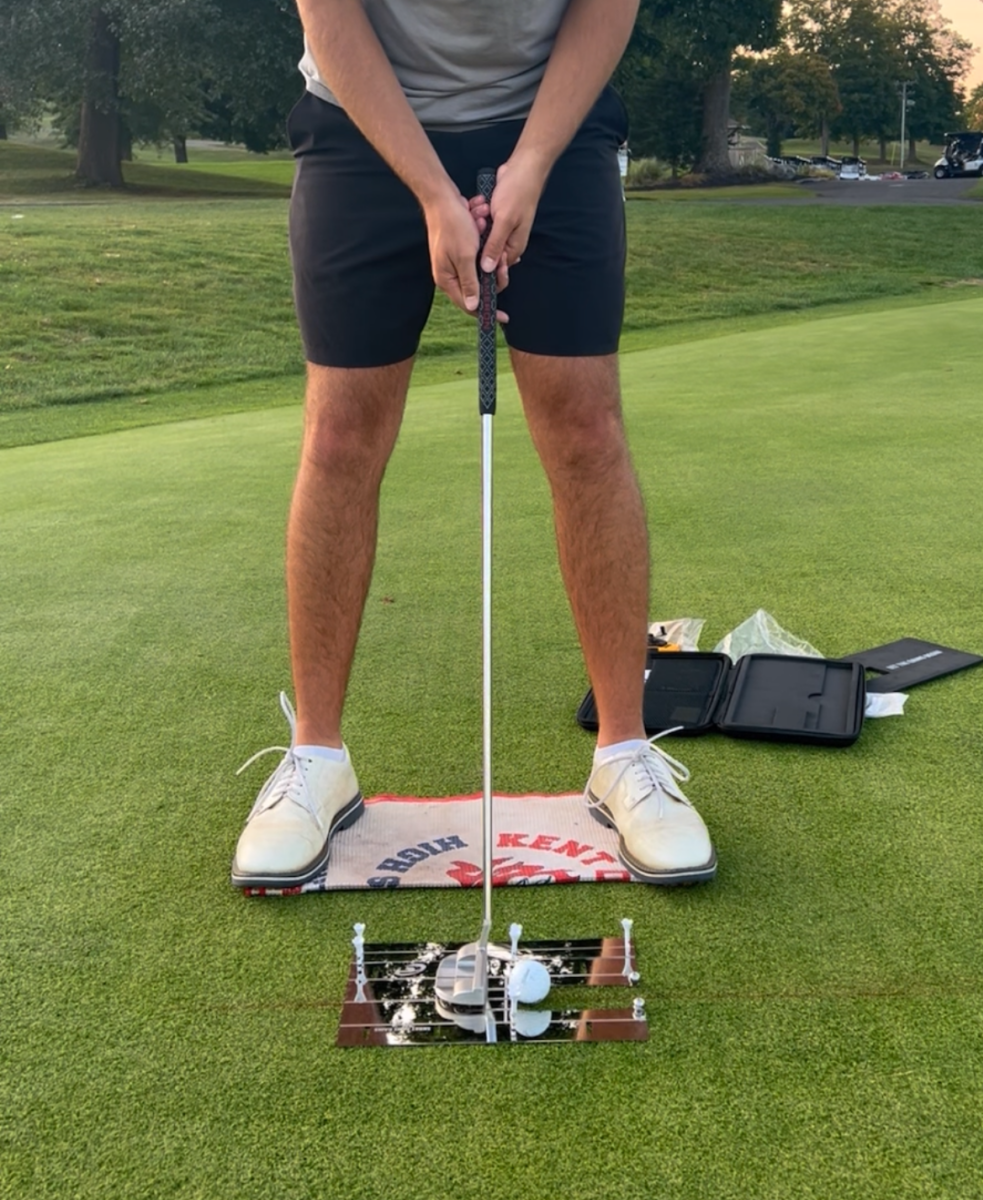
Once I arrived on campus, practices were starting nearly right away. I thought I was well prepared to compete, but I was met with an issue. My putting was very bad. I was able to be successful in youth golf and in high school by being an exceptional ball striker, but everyone in college is a good ball striker. I was very behind, and I needed to adjust quickly. One thing that I did to improve was practice putting every day after practice for an extra 30 minutes. While this doesn’t seem like a long time, doing it every day helped me make monumental strides in my putting. I used a putting aid most days, which had marbles on both sides of the putter head. If my putting stroke was too far to the outside or too far to the inside, I would hit one of the marbles. 

After many hours of practice using this putting aid, I was able to catch up to the rest of my teammates, and later on in the fall, I made my debut at Hamilton, having qualified to play in the tournament. My improved putting allowed me to play in tournaments early on in my collegiate career.

Investing in My Future

How I Built My Resume

After my summer interning in Wealth Management, I realized that my sophomore fall semester was going to be an incredibly busy time. I was going to have to look for internships for my sophomore summer, as well as actively recruiting for investment banking internships for my junior summer.

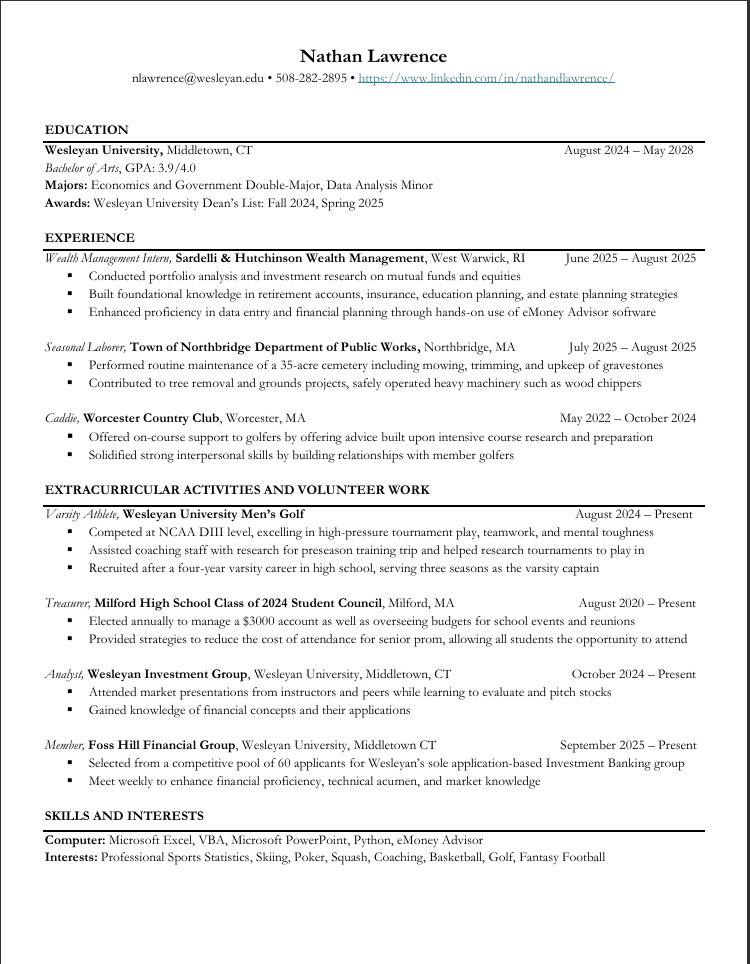
In order to do all of this, I needed a resume to be able to put all of my experiences and skills on. Part of what pushed me to complete my resume so early was that I needed to apply to Foss Hill Financial, Wesleyan’s investment banking club. That application required a resume, so I had to get it done. I researched templates on Wesleyan’s Gordon Career Center website to find one that fit best for financial services roles. The website had templates for all career paths, so I used their recommended finance template. I started putting in my information. The process was not as easy as I thought it would be. Summarizing the work I did over the summer in just a few bullet points is very difficult. There are so many things that I did during my summer, and it was difficult to summarize in just a few words the things I did.

I reached out to my roommate, who had already worked on his resume in the past. We called one night to walk through the process of putting together the resume. We had a shared document that we both could edit and add information on. This document became how we communicated during the process. I would ask questions in the comments section, he would answer with his best input, and he would make edit suggestions for me to look at.

After a lot of hard work, I was able to send my resume into the Gordon Career Center for somebody to look at and approve. I got an email back a few days later saying that my resume was approved and ready to be sent out. Shortly after, I submitted my resume to Foss Hill Financial, and I got an interview.

After prepping for the interview, I was able to secure my spot in the club. As a part of the club, I was assigned a mentor to help with the process. He also looked at my resume and made minor suggestions for edits and rearrangement. After meeting with him to discuss my resume, he decided that it was also ready to be sent out to begin the search process for my sophomore internship, as well as my junior internship. 

Refining My Technical Skills

My Experience with Python

Coming into Wesleyan, I made it my goal to take a few classes on programming and other technical skills. In the spring, I took a class in Excel and Python through the school’s Quantitative Analysis Center. Excel wasn’t very technical, but the course helped me develop a basic understanding of how to use the program for data analysis, which is a helpful skill in finance. 

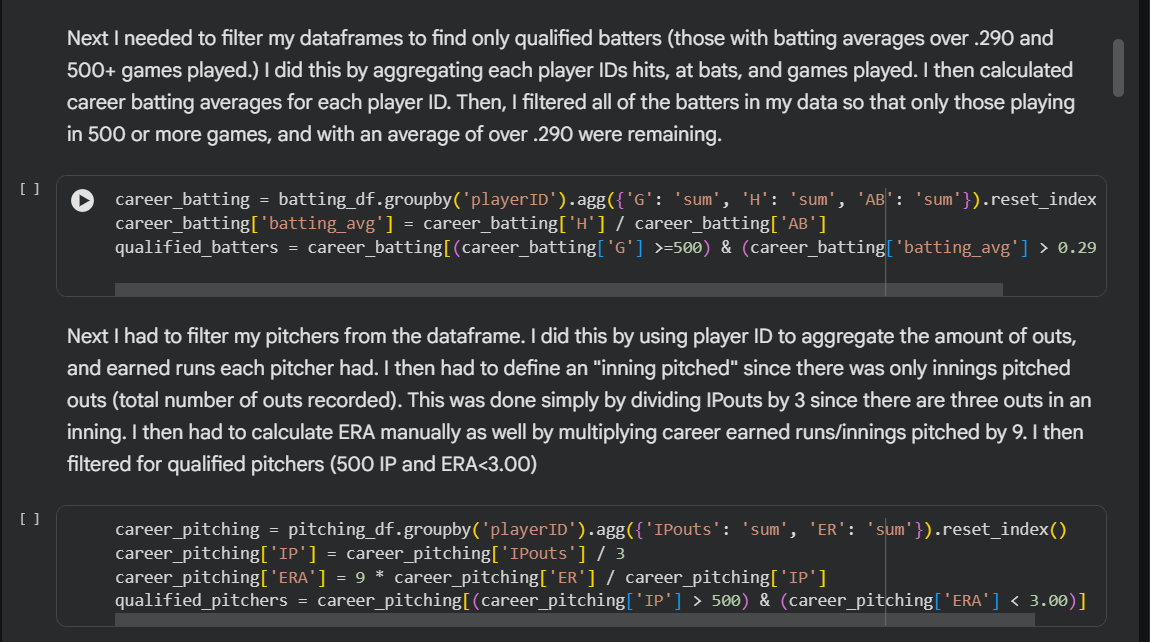
I wanted to take my skills to the next level, so I also signed up for a Python class the next quarter. I had never learned a programming language, but this class challenged me to learn how to use Python for data analysis. The final component of the course was a project where students had to find online datasets and analyze any trends they found. I decided to look into baseball statistics, something that I enjoy looking at in my free time. Using a massive pool of players and their career statistics, I tried to define a threshold for these statistics that would define any one player as a “good player.” To define this, I relied on  batting averages and OPS (On-Base Plus Slugging%) for position players, and ERA (Earned Run Average) as well as WHIP (Walks+Hits/Innings Pitched) for pitchers. 

The most interesting part of the project was when I tried to locate the states that produced the highest number of  “good players.” I presented this data on several graphs, showing that Texas, Florida, California, and Georgia produced the most “good players.” But this wasn’t a deep enough insight for me—obviously, Texas, Florida, and California would have the most players, because they are all highly-populated states in warmer environments, and are generally considered superpowers for sports. Then, I decided to look into the number of “good players” per capita in each state. These numbers were more revealing. Ohio, New Jersey, and Pennsylvania were among the top five states with the  highest number of “good players.” I was really interested in the findings that I found and it was overall a really interesting project to work on, and it was fun to do. 

My Summer in Wealth Management

About My Internship Experience

In the summer of 2025, I had the wonderful experience of interning at a wealth management company called Sardelli & Hutchinson Wealth Management. Through this experience, I developed a ton of skills that will help me manage the rest of my career at Wesleyan as well as prepare me for future internships or job opportunities. I started working at the end of May and I knew the very basics of wealth management but was willing to come in as a sponge and learn as much as I could from the advisors. Early on, there was a lot of training that I had to complete, learning some more things about retirement planning, estate planning, education planning, insurance, and a lot of information about regulations. I found those first two weeks very informational and it helped me learn the ropes, but I was also looking forward to being assigned work.

Around mid-June, I was assigned my first project. I was told to do some data entry in the software we used called eMoney Advisor. I was given a few info sheets from new-client meetings from the advisor I worked with and was tasked with inputting all of the information into our simulation program. While it wasn’t super difficult, it was tedious and I found myself getting crossed up with some overlapping information.

To help with this, I made a layout on a piece of paper and wrote everything out rather than trying to input everything right away. This allowed me to cross mistakes off and rearrange things without having to re-run the simulation. I was able to complete the task pretty easily using this method. Later on in the summer, the firm was rebalancing their positions in certain mutual funds, and I was tasked with finding replacement funds with similar fees as the ones we were replacing. I was able to gain knowledge on certain mutual funds as well as use Morningstar, a website that shows information about investments. It was a very interesting experience interning in wealth management, and I was able to learn a lot about the industry while building skills and experiences that will help me going forward. 

Pivoting My Podcast

About My Podcast Creation

During my Freshman fall, I took a class called Intro to Podcasting. It was a workshop course, meaning that it wasn’t meant to be all lectures and exams, rather, it was working on a project over the course of a semester, using information learned in class to help.

We started the class off by brainstorming ideas for a podcast. I knew that in order to be successful in this class, my podcast had to be about something I truly cared a lot about. I chose to do my podcast on New England Sports, partially because I could talk for hours on end about it, and also because my family has a history in sports media, and I felt it would be really cool to extend that history.

We learned how to use a software editing program called Audacity, which allowed me to clip certain parts of my audio recording which I did with my best friend from home, and place those clips in whatever order I wanted them to go. This allowed me to place parts of my recording in places that made more sense in the final project. I could also adjust the volume and pitch of the sound, as well as cut out anything that I didn’t want or that didn’t sound good.

A lot of the class was taking peer feedback and using it to revise. I ended up getting feedback that made me completely pivot my podcast episode. I was told that my podcast felt too informational, and that only seriously dedicated Boston sports fans would listen. I agreed. I was told that the people of ESPN hardly talk about sports at all, they just argue, and people watch. I also agreed. I re-recorded my episode with one of my teammates, who I disagreed with a lot. The new section was way more combative and engaging for the listeners, and as a result, the new result was much better. My classmates and my professor really liked the new episode. 

css.php