
My Experience with Python
Coming into Wesleyan, I made it my goal to take a few classes on programming and other technical skills. In the spring, I took a class in Excel and Python through the school’s Quantitative Analysis Center. Excel wasn’t very technical, but the course helped me develop a basic understanding of how to use the program for data analysis, which is a helpful skill in finance.
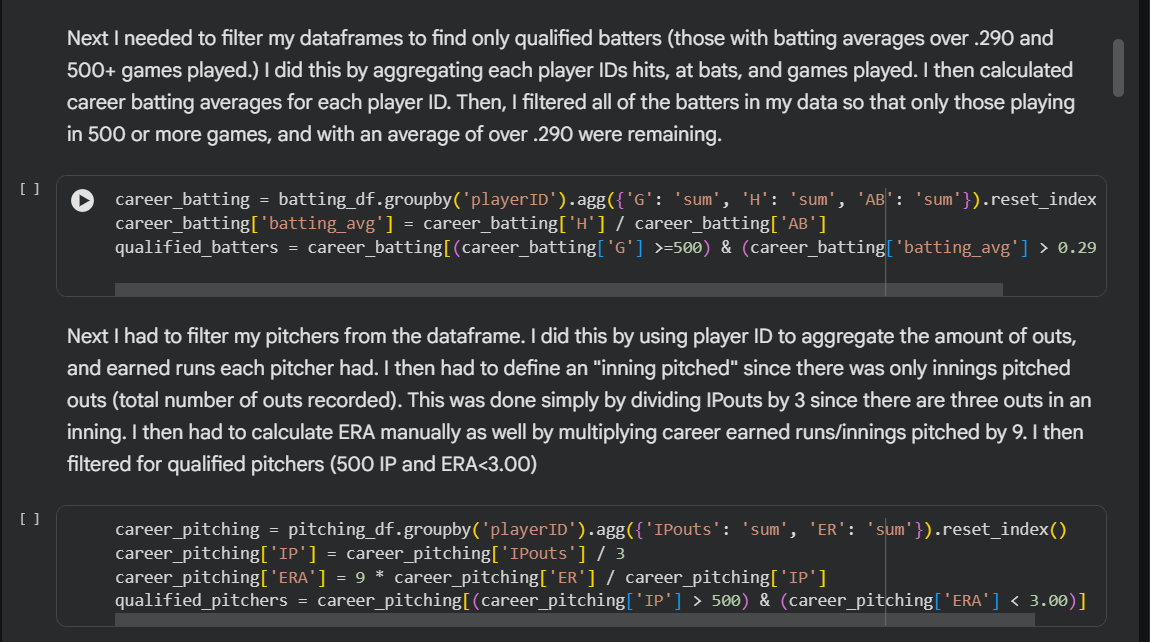
I wanted to take my skills to the next level, so I also signed up for a Python class the next quarter. I had never learned a programming language, but this class challenged me to learn how to use Python for data analysis. The final component of the course was a project where students had to find online datasets and analyze any trends they found. I decided to look into baseball statistics, something that I enjoy looking at in my free time. Using a massive pool of players and their career statistics, I tried to define a threshold for these statistics that would define any one player as a “good player.” To define this, I relied on batting averages and OPS (On-Base Plus Slugging%) for position players, and ERA (Earned Run Average) as well as WHIP (Walks+Hits/Innings Pitched) for pitchers.
The most interesting part of the project was when I tried to locate the states that produced the highest number of “good players.” I presented this data on several graphs, showing that Texas, Florida, California, and Georgia produced the most “good players.” But this wasn’t a deep enough insight for me—obviously, Texas, Florida, and California would have the most players, because they are all highly-populated states in warmer environments, and are generally considered superpowers for sports. Then, I decided to look into the number of “good players” per capita in each state. These numbers were more revealing. Ohio, New Jersey, and Pennsylvania were among the top five states with the highest number of “good players.” I was really interested in the findings that I found and it was overall a really interesting project to work on, and it was fun to do.